
Open courts, case closed
Journalists are fighting for your right to a justice system you can trust.

In principle, the principle of open courts means just that. Courts that are open.
In practice, well. It depends. So when a group of folks at the Canadian Association of Journalists thought we should see if we can do something about that, I didn’t have to be asked twice to join. And this past weekend at the annual conference at Carleton University’s Journalism School, our little group came up with what might possibly be the beginning of a solution.
I’m a weird hybrid beast in that I never went to journalism school. I went to law school instead. But I never practiced law. You could say I have trouble choosing, or maybe I’m commitment-avoidant. Either way, being at the junction of both disciplines can come in handy.
It is one of the fundamental principles of justice — the kind of shit they drill into your head in the first semester of your first year — that not only must justice be done, it must appear to be done.
The origin of this principle goes back a century. In 1923 England, a motorcyclist named McCarthy hit another motorcycle, hurting a man and his wife who was in the sidecar. McCarthy was charged criminally and the injured party sued him in civil court for damages.
McCarthy was convicted of dangerous driving. What McCarthy and his lawyer didn’t realize until after the verdict, was that a clerk to the justices was also a member of the firm that was suing him for civil damages — and the clerk had been in the room with the justices as they were deliberating in his criminal case. The clerk and the justices swore that the clerk had not taken part in the deliberations or discussions.
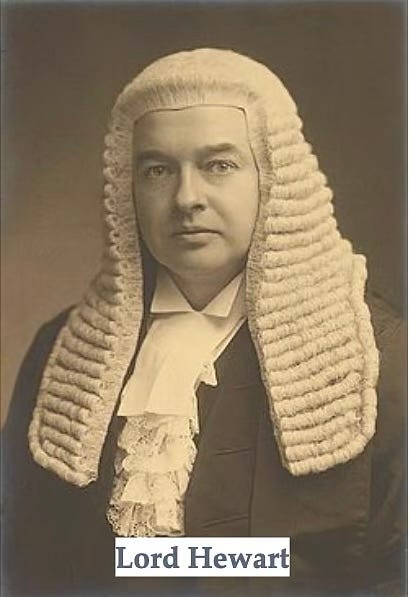
McCarthy sought to have his conviction overturned and the case went before the Chief Justice of the Court of King’s Bench, Lord Hewart. He did believe the clerk and the justices that nothing improper had taken place during those deliberations, but he ruled that it’s not what happens that matters so much as what might have happened behind closed doors. He delivered these final words, which should be tattooed on everyone’s brains:
… it is not merely of some importance but is of fundamental importance that justice should not only be done, but should manifestly and undoubtedly be seen to be done.
You may even go back further in time, all the way to the Magna Carta of 1215, for basic principles of natural justice to be enshrined in formal texts. For how could we regular people have faith that the justice system is, well, just, if we can’t see how it operates?
We have some jurisprudence in Canada that reaffirmed the principle of open courts. In 1982, in Nova Scotia v. MacIntyre, the Supreme Court emphasized that proceedings must be open and accessible, otherwise the public would not have confidence in the system’s fairness and integrity. The case involved a reporter who was denied access to search warrants and related material by the Justice of the Peace who had issued them. Justice Dickson, writing for the majority, wrote that, “Curtailment of public accessibility is justified only where the need to protect other social values is of superordinate importance.”
Then two cases contributed to refining the rules about publication bans. The 1994 Dagenais about catholic priests charged with physical and sexual abuse of young boys who asked the court to stop the CBC from broadcasting or promoting The Boys of St-Vincent, a dramatic mini-series based on real events about the abuse of young boys by catholic priests until the trial was over, as well as order a publication ban covering the application. In 2001 in Mentuck, a publication ban was requested to protect the identity of undercover cops involved in a murder investigation.
The Dagenais-Mentuck test says exceptions to the open court principle (like publication bans) can only be granted if they are necessary to prevent a serious risk to an important interest (like trial fairness or national security), the benefit of the order outweigh the negative and the order is as limited as possible under the circumstances.
Notably, a desire for privacy is not enough to justify a publication ban, as the Supreme Court said in the 2021 Sherman case (the still unsolved murder of the Toronto billionaire couple). The party asking for a ban has to show that there is a serious risk of harm that overrides the public’s right to know. (Protecting the identity of minors is a completely separate issue.)
As the Supreme Court notes on its website, the open court principle “serves to instill public confidence in the justice system.” And it’s worth noting that the SCC is doing a fine job of making its proceedings public and easily accessible — both in French and English. You can watch oral arguments, consult the documentation, see who’s involved and what they are pleading. The Court also publishes case summaries in plain language that are meant to help interested Canadians understand what’s happening. The Court also provides briefings to the media to explain judgements and answer questions.
It’s at lower levels that the shit hits the fan. During a video call with dozens of journalists who cover judicial affairs from all over the country earlier this month, we each took turns describing challenges to the open court principle we encounter in our work. This isn’t meant to try and elicit sympathy for how hard we work; if journalists can’t access records that are meant to be public, they can’t tell you what’s happening in your criminal court in a case where a cop is accused of having broken the rules and hurt someone. Wouldn’t you want to know what evidence the crown has against that cop? What if that cop is acquitted and nobody can show you why?
In theory, the principle should apply everywhere. Listening to my colleagues in every part of the country, the practice is far from that ideal. From restricting access to audiences (in person or virtually), to preventing the release of documentation that should be public, to having websites that make finding information unduly difficult to accidentally misplacing files or incorrectly spelling names to make high-profile cases impossible to track — everywhere and everyday we find obstacles to open courts.
What came out of that panel at Carleton is still taking shape, but we know where we’re starting from: A good old-fashioned gumshoe job of documenting failures across every jurisdiction. This matters to you even if you never go anywhere near a courtroom. Justice must be seen to be done, even if you, personally, aren’t looking at it.